Mobility Sweden - giving voice to the vehicle industry
For being a relatively small country with only ten million inhabitants, Sweden is nearly unique globally by having several major vehicle manufacturers with both production and development in the country. That means the Swedish vehicle industry has enormous importance for Sweden's economy and politics. The Swedish industry organisation Mobility Sweden, previously BIL Sweden, gathers manufacturers and importers of passenger cars, lorries and buses, and is therefore a heavyweight player that gives member companies a common voice to drive issues such as the green transition, electrification and mobility. Together, members account for 97% of new-car sales in the country.


Basis for political decisions In addition, Mobility Sweden is the official source for new registrations of passenger cars, buses and lorries. On the first Monday of each month, new-registration statistics are published to the country's major media. Together with Mobility Sweden's analysis, the statistics form a good basis for decision-makers and other stakeholders to make well-grounded decisions about the vehicle industry. During 2024 Mobility Sweden changed main supplier of vehicle data, and Bilvision was awarded the assignment to provide the organisation and its members with current data on new registrations in Sweden.
The challenge: From text files to a modern platform
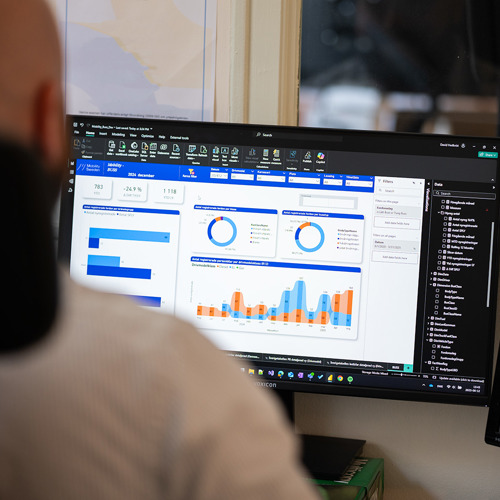
When member companies began to demand more detailed follow-ups and analyses of new-car registrations, Mobility Sweden put out the assignment to build a modern statistics platform, asking for interactive reports and greater flexibility in the analyses.
- The majority of the existing deliveries consisted of digitalised text files and PDFs, which was neither particularly user-friendly nor flexible. Mobility Sweden therefore wanted a more engaged and responsive partner who could create more detailed reports and carry out customisations of the statistics, says Jesper Wiig Sundelin, Head of Business Development at Bilvision.
The assignment from Mobility Sweden was therefore based on delivering "a modern and future-proof statistics platform". Thanks to its leading position as a supplier of vehicle data and good reputation among Mobility Sweden's member companies, Bilvision was awarded the assignment. The timeline for delivery of the project was 18 months.
- Our first step was to sort out the offer brief; what did they actually mean by a "modern and future-proof statistics platform"? Which underlying needs are tied to that? So we started work on mapping out who the stakeholders were, and by holding interviews trying to understand them, their requirements and their needs both now and in the future - to ensure that delivery would be as good as possible, says Jesper.

New deadline: From 18 to 3 months
In the middle of the needs mapping, a message suddenly arrived that would affect the entire effort. It was approaching Christmas and the holiday break when the conditions for the project were completely redrawn; due to external circumstances, Mobility Sweden and the member companies risked being left entirely without business-critical reporting bases unless Bilvision could deliver the project faster. Much faster.
- Since Mobility Sweden didn't want to risk being without statistics, the timeline was changed from the original 18 months to having a finished platform in only three months. It's clear that put everything on the line. But we also felt it was a challenge we could handle - we just had to start prioritising which core functionality was important in a first version, and what would be part of a long-term delivery. But really we just followed our main plan, we just had to do the project a little differently and push from several fronts at once by parallel-developing certain pieces, Jesper explains with a smile.
Bilvision created an internal Mobility Sweden team, leveraging staff's different competencies to deliver in line with the assignment - from database development to IT security.
Long experience and broad expertise
The advantage in this particular project, and a big reason Bilvision could keep to the short deadline, Jesper believes is down to the team's experience and the ability to build on much existing work.
- Since we had done several similar sub-projects before, we were confident in our competence regarding the various components the delivery encompassed - for example, building a database, setting up an import, building an API, producing statistics and making file deliveries. With that insight we knew we'd solve it, despite the project's complexity, Jesper concludes.

In the next part: How Bilvision improved insights and analytical capability with Power BI reporting
In part two we describe how Power BI solutions, among others, made a big difference for users - from hand-built reports to interactive ones.